The word you cannot escape
Say the letters "AI" in any newsroom, classroom, shop, or drawing room in Pakistan today and everyone nods. Few people can say what the letters actually mean. That gap matters now more than ever, because the World Bank's October 2026 economic update for the Middle East, North Africa, Afghanistan and Pakistan - titled "From Divide to Opportunity: AI, Jobs, and Growth" - places Pakistan among the world's top five suppliers of services on major online work platforms, across more than 2,700 skill areas.
In other words, Pakistanis are already selling AI-related work to the world. About 75,000 IT graduates enter the market every year, and ICT services exports hit a record $4.6 billion in fiscal 2025-26. Understanding this technology is no longer an academic hobby. It is a practical skill, like reading a balance sheet or driving a car. This guide explains it the way a good teacher would: plainly, honestly, and without the sales pitch.
So, what is AI, actually?
Strip away the marketing and artificial intelligence is software that finds patterns in data and uses those patterns to predict something or decide something. A spam filter that learns which emails you delete is AI. A phone keyboard that guesses your next word is AI. A chatbot that answers in fluent Urdu or English is AI.
Three ingredients make all of it work. First, data - huge amounts of it: text, images, numbers, sounds. Second, a model - a mathematical system that studies that data and learns its patterns. Third, computing power - the machines that do the studying. When people say "machine learning," they mean the middle part: the system improving at a task by studying examples, rather than by following rules a programmer wrote line by line.
The most famous models today are large language models. They were trained on enormous piles of text, and they work by predicting what words plausibly come next. That is why they write so fluently — and also why they can be so confidently wrong. They do not understand truth the way a person does. They produce language that sounds right. Knowing that single distinction protects you from most AI mistakes.
How a machine "learns"
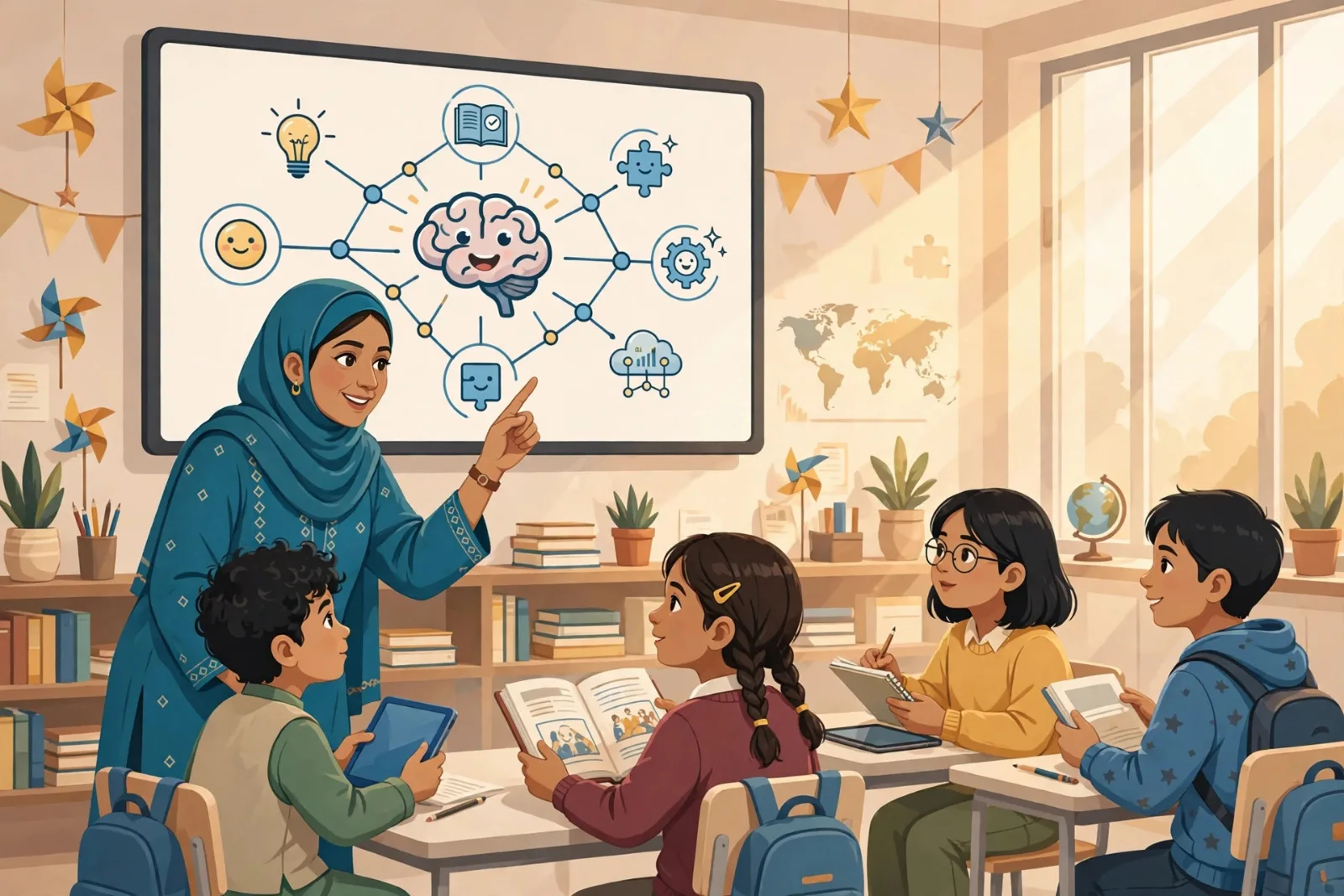
Think of a child learning to recognise a mango. Show the child ten mangoes and ten apples, and soon the child knows the difference without anyone writing down a rule about colour or shape. Machine learning works on the same principle, at a scale no human can match: millions of examples instead of ten.
Once trained, a model is put to work. You give it something new - a sentence to translate, a photo to describe, a spreadsheet to summarise - and it applies the patterns it learned. This is why AI is good at tasks with clear patterns and plenty of examples, and weak at tasks that need judgment, common sense, or genuine understanding of a situation it has never seen.
What AI does well - and where it fails
AI is already strong at language work: drafting, summarising, translating, and answering questions. It is strong at images: generating pictures, reading scans, describing scenes. It is strong at code: suggesting the next lines, catching simple errors. And it is strong at crunching data: finding trends in numbers that would take a person weeks.
It fails in ways worth remembering. It invents facts, a habit researchers call hallucination - it will state a false date or a fake quote in perfect, confident prose. It repeats the biases hidden in its training data. It has no conscience and no sense of responsibility. And it cannot tell you when it does not know something; it answers anyway.
The practical rule follows from this: treat AI output as a first draft, never as a final verdict. Check names, dates, and figures. If a claim matters - in a news story, a contract, a medical note, a court filing - verify it from a real source before you use it.
Will AI take jobs?
This is the question everyone asks, and the World Bank report gives a calmer answer than the headlines suggest. Across the region, AI could raise productivity in 13 to 20 percent of jobs, while fewer than 10 percent of jobs face near-term automation risk. The bigger story is not replacement. It is augmentation: a teacher who uses AI to personalise lessons, or a property agent who uses it to match buyers faster, becomes more effective, not redundant.
Pakistan sits on both sides of that story. The same online freelance market that earns the country dollars is exposed as AI begins doing some outsourced tasks itself. The report notes that Pakistan records the highest absolute number of AI conversations in the region, but that use is concentrated in arts and media - graphic design, content creation, translation - rather than software. That is a warning and an opportunity at once: the talent is real, but it needs to move toward deeper, harder-to-replace skills.
The language problem nobody talks about
Here is the finding that should matter most to a Pakistani reader. Urdu accounts for just 0.03 percent of global web addresses collected by Common Crawl, one of the largest datasets used to train AI models. Arabic and Persian each account for about 0.7 percent. English accounts for 40.6 percent.
That imbalance has a direct consequence: AI tools understand English far better than they understand Urdu, because they were raised on English text. A model that writes beautiful English and clumsy Urdu is not being unfair on purpose. It is reflecting what it was fed.
Pakistan's answer, as described in the report, is a $1 billion programme running through 2030 that includes a sovereign multilingual AI model, shared GPU infrastructure, 1,000 AI PhD scholarships, and training for one million non-IT professionals. The country has also set a target of training 200,000 people in AI every year, with 3,000 postgraduate scholarships — the largest annual training target among the national strategies the report examined. Whether those numbers are met is the real test. But the direction is right: if Urdu speakers want AI that serves them well, Urdu data and Urdu-capable models have to be built, not wished for.
Small AI: the practical path
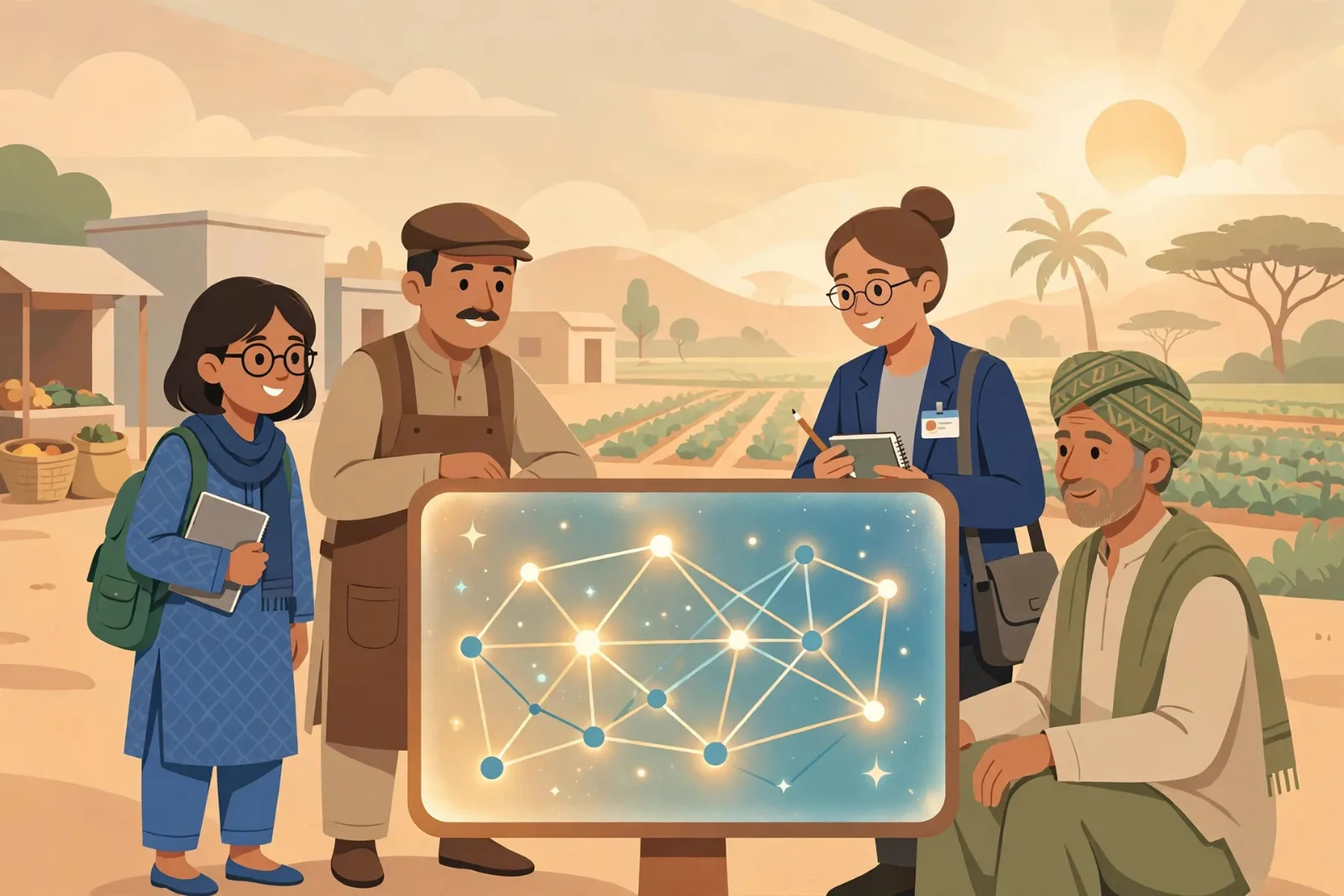
Not every useful AI system needs a supercomputer. The report highlights what it calls "small AI" — affordable, purpose-built applications that run on basic mobile phones, low-bandwidth connections, and intermittent power. These are tools for agriculture, health, and education that do not need frontier-level computing.
That idea deserves attention, because it describes the AI that fits most of Pakistan: a shopkeeper checking stock with a phone camera, a student in a small town getting study help in Urdu, a farmer getting advice on pesticide use, irrigation, or yield estimation. The national AI strategy marks agriculture as a key area for exactly these uses. The future of AI in Pakistan will not be decided only in glass offices. It will be decided in shops, classrooms, and fields.
How to start, without fear and without worship
If you are new to all of this, start with one real task from your own work. Write a clear instruction to an AI tool: what you want, who it is for, and what a good result looks like. Give it an example if you can. Then check what comes back, and correct it. That loop — clear instruction, checked output — is the whole skill, and it improves with practice the way any craft does.
Do not fear the technology, and do not worship it either. Fear makes people avoid tools that could help them. Worship makes people trust tools that should be checked. The sensible middle is curiosity with discipline: use AI daily, verify always, and keep learning. The doors are open wider than they have ever been — training programmes, scholarships, and free tools are within reach of anyone with a phone and patience.
The question that actually matters
The question is not whether AI will matter to Pakistan. It already does - in export earnings, in freelance work, in classrooms, and in government plans. The question is whether Pakistanis will be passive users of other people's models, or builders of their own capacity: their own data, their own models, their own skills.
Understanding AI is the first step from the first position to the second. You do not need a degree to take it. You need a clear picture of what this technology is, what it does well, where it fails, and how to use it with your eyes open. That is what this guide tried to give you. The rest is practice.